|

 igeria's performance at the London 2012 Olympics was awful. Humorously speaking, our athletes and officials only "went to London to see the Queen". Vanguard of Thursday, August 9, 2012 noted that "Only few athletes reached the finals of their events. Nigerian boxers were pummelled out, weightlifters wobbled out, table tennis players spun out with ease. Nigeria simply did not prepare well and they lack world class athletes due to the failure of the authorities to develop sports. They are reaping what they sowed". igeria's performance at the London 2012 Olympics was awful. Humorously speaking, our athletes and officials only "went to London to see the Queen". Vanguard of Thursday, August 9, 2012 noted that "Only few athletes reached the finals of their events. Nigerian boxers were pummelled out, weightlifters wobbled out, table tennis players spun out with ease. Nigeria simply did not prepare well and they lack world class athletes due to the failure of the authorities to develop sports. They are reaping what they sowed".

|
 advertisement advertisement
|
The column has written before about how "a day before is always better than the one after" in Nigeria, and that has been manifesting in all the facets of Nigerian life. Taking the Olympics as an example: Nigeria performed better in Atlanta in 1996 than it performed in Sydney in 2000! And, Sydney 2000 was better than Athens 2004 for Nigeria in terms of performances. In 2008, Nigeria managed to win few medals in China, but, in London 2012, the country recorded the worst performance ever (apart from during the 1988 Seoul Olympics), by not winning even a single medal. Falilat Ogunkoya, who won bronze in the Atlanta Olympic Games in the 400m, put it succinctly when she said that "Nigeria went to sleep after Atlanta 96". Falilat Ogunkoya told the Vanguard that at the same Atlanta '96 Olympics, Mary Onyali won bronze in the 200m and Chioma Ajunwa won gold in the Long Jump before the soccer team also won gold, making it Nigeria's finest moment at the Olympics. In Falilat's words: "We went to sleep after Atlanta '96. It was largely the Atlanta team that competed in the 2000 Games in Sydney and some athletes remained till 2004. So, we went to sleep after Atlanta '96 and the result is what we are getting now. After we won in Atlanta did they ask the medal winners how they won? What we went through should have been a lesson, some kind of guide to the authorities. People are so greedy now and they don't help athletes. Here, in England, Britain invested in sports and they are reaping it now. So, after everything the question goes back to the President of Nigeria. What does he want to do with sports?"
Failure follows Nigeria everywhere (at home and abroad). Nigeria is like a giant tree that has withered due to disease and lack of water (corruption and bad leadership). What needs to be done is "to chop the dead tree down and uproot the stump". Then, on a fertile ground, a new plant that will be nurtured to a giant and fruitful tree, should be planted to replace it.
Just as Will Rogers (1879-1935) wrote that "If you find yourself in a hole, stop digging", we have wasted a lot of time and resources trying to maintain what has deified all efforts in that regard. The best should be to let it wither and then to start anew to build a new nation. We learnt that the government is planning an elaborate and expensive centenary celebration (the 100th year anniversary) of the 1914 amalgamation of the southern and northern protectorates. That's uncalled for! We don't have to celebrate failure and deceit. For instance, somebody that fails an exam shouldn't be celebrated; rather, he should be encouraged to try better next time. That's what Nigeria needs to do.
The Punch of Sunday, August 19, 2012, in its editorial, wrote this excerpt:
"It is amazing that amid the serious crisis of nationhood afflicting the country, the Jonathan administration is busy planning a year-long centenary celebration in 2014 to mark the 1914 amalgamation of the northern and southern Nigeria protectorates. But the British amalgamation was nothing but the culmination of years of conquest of independent kingdoms, empires and states that were then forcibly yoked together for greater exploitation. No people in the world celebrate their defeat and subsequent subjugation by a conquering colonial power. Nigeria should not be the exception. A World Bank unit has continued, for seven years, to list Nigeria as one of the world's fragile states with its economy falling off the cliff. Thirteen years into the Fourth Republic, ethnic and sectarian violence and the desperate contest for presidential power, among others, have killed over 5,000 persons, making analysts to recall the famous quip by the late premier of the defunct Northern Region, Ahmadu Bello, on the need to correct "the mistake of 1914? and the reference to Nigeria as "a mere geographical expression" by the late premier of the defunct Western Region, Obafemi Awolowo. Nigeria, almost 100 years on, remains both a mistake and a geographical expression. Regrettably, President Jonathan has not shown a sound understanding of this dire situation. The urgent task before our leaders therefore should be how to restructure the nation for development in the face of the failure of the current structure to deliver either development or unity among the over 250 ethnic nationalities".
While others are modernizing their sports, ours is going moribund and obsolete. If we can win medals in 1992 or 1996, why should our Olympic team come back home, from the Olympics, in about 20 years later, without a medal? The last time Nigeria left the Olympic Games without a medal was 24 years ago in the Seoul Olympic Games of 1988. The point is that Nigeria has struggled to its peak. From now on, it will be a downward spiral (free for all fall) for it.
Nigerian Medalists at the previous Olympics
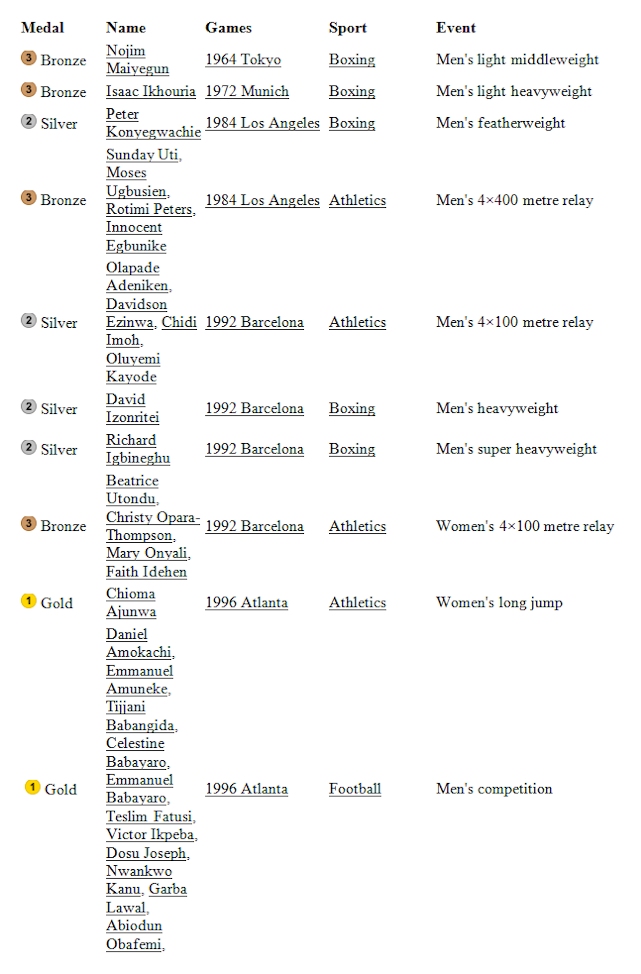
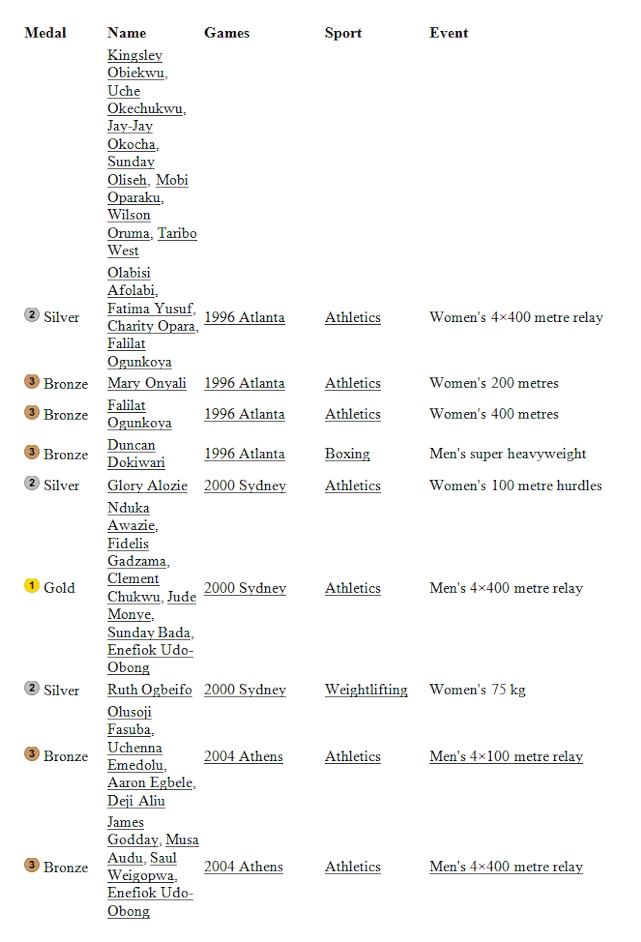
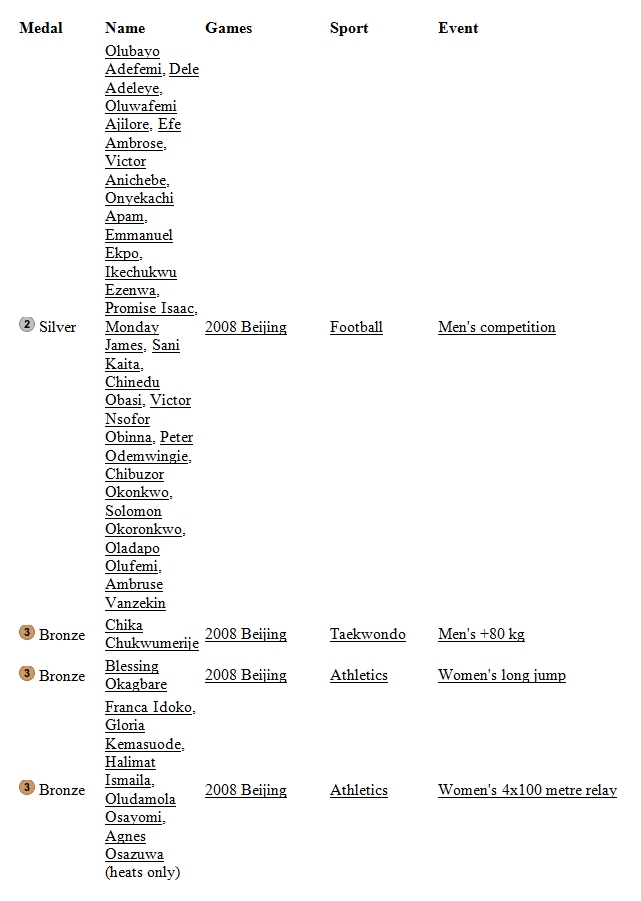
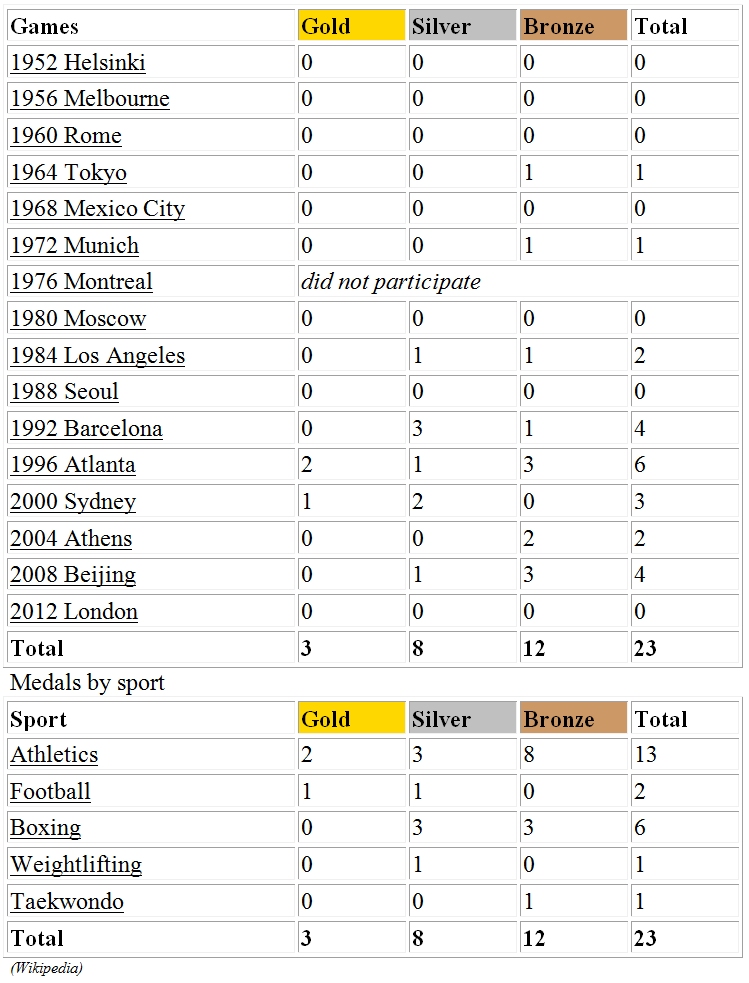
Medal tables
Medals by Games
Some of the factors which led to Nigeria's dismal Olympic performances are:
Corruption
Sports in Nigeria needs restructuring in order to make it more result-oriented! Although more than N2 billion was released for the Olympic Games in London, the money ended in some officials' pockets, and even there was bickering amongst them on how the money was shared. That was the money that should have helped Nigerian athletes prepare well for the games. The little the officials in-charge allowed to trickle down for the training of our athletes was released late and didn't help Nigeria or the athletes in any way.
To prove that the sum of N2.3 billion was released late; the Vanguard wrote that one official lamented about it (as the London games were going on) thus: "N2b can help our sports and help us win gold medals at the Olympic Games if it is released in time and spread over four years for preparation," the official said, lamenting that the last minute release of funds only creates room for corruption as the whole money is hardly used for the purpose for which it was meant. About N2.3 billion was said to be the total so far released for the London games but I am sure that they have not spent more than N800m on our preparation and they couldn't have spent more than N200m here in London because the host is providing accommodation, feeding the athletes and providing some other logistics for all teams," the official said. He continued: From the last Olympics in Beijing till date if we used N2b to develop our athletes, train them, expose them and enter them for competitions I will be telling you how many gold medals we can win here in London".
Corruption that is almost a way of life in Nigeria is also preventing Nigeria from excelling in international sporting events. Nigeria won no gold, no silver and no bronze at the London games, meaning that a whopping sum of N2.3 billion spent was wasted.
To prove that a huge chunk of the N2.3 billion was diverted by officials for personal use and lavish spending on themselves; the Vanguard of August 13, 2012, wrote that "the story of Nigeria at the 2012 London Olympics is "No gold, no silver, no bronze, N2.3 billion down the drain." And now a top Nigerian sports official who is a member of an international sports federation wants the federal government to compel the sports ministry to account for how they spent the N2.3 billion government released for the Olympic Games which ended in London yesterday. He would not have his name on print. He said the ministry should disclose how much they released to each sports association that presented a team to the Olympic Games. Athletics, Weightlifting, Taekwondo (athletes) Canoeing (one athlete), Wrestling, Basketball, Table Tennis and Boxing associations presented teams at the games. All the athletes were 51. The number of officials was still unknown as there were many who were not accredited and, consequently, were not useful to the athletes. They stayed in their hotels to watch the games on television. This irked the Nigerian official and he described the action of the ministry as "wasteful". He said it was necessary for the ministry to disclose the allocations to each association because of what he called "the wrong decisions" that partly affected Nigeria's preparation to the games. The official said the following: "Taekwondo that presented two athletes was given over N65m to prepare while Athletics that had over 100 athletes but which they pruned to 28 for the Olympics was given N131m. Basketball which had to travel to Venezuela for their qualifying tournament was given N75m for all their preparation including the tournament in Venezuela. The rest of the sports did not get more than N500, 000. And yet N2.3 billion was released for the Olympic Games. But the money came in instalments and it came so late that nothing much could be done with the last instalment. This is not the way to prepare for the Olympic Games. The people who disbursed the money took wrong decisions and now the athletes are saying that they did not prepare well. The ministry is to blame."
Lack of facilities and training
Makanjuola Nureni, a FIFA Player's Agent, was right when told the Vanguard that Nigeria was losing its athletes, especially footballers, to other countries due to poor training facilities. He claimed that the country was losing its athletes because the government was paying more attention to politics rather than concentrating on harnessing the country's abundant talents.
A weightlifter, Felix Ekpo, who represented Nigeria at the London games, bemoaned the condition of Sports in Nigeria when he told Vanguard of Thursday, August 2, 2012, that he wished that sports development and its administration were different in Nigeria. Ekpo wished that things were done differently in Nigeria. In his words: "You don't come to the Olympic Games and say you want to win gold without preparing for it," he said while chatting with this reporter at the Weightlifting venue. We camped in Germany which was good but it takes more than camping to win gold at the Olympics. It's a whole package that has to do with nutrition, training, exposure and competitions. When you compete regularly you meet the same people you will meet at the Olympics, you will learn more techniques and develop confidence. You can't win gold at the Olympics by hurriedly preparing and going for last minute camping. Here, at the Olympics, you hear athletes saying that they prepared for four or five years and you feel out of place, you know that only God can help you and with a feeling you strive that the best comes out of you. Someday, we will get it right in Nigeria."
The facilities for training are not there and we afford our athletes no opportunity for overseas training like some many countries did. For instance: The Chinese swimmer, Sun Yang, who broke the world record in 1500 Meters Freestyle, did his training in Australia (and was trained by an Australian). China sent him there for training and it paid off. Sun Yang won the gold in 1500 Meters and 400 Meters respectively; he won the silver in 200 Meters and the Bronze in 4 x 200 Meters relay.
Wrong selection
Of course, Nigeria can't win Olympic medals without preparing well for it or by going there with sick athletes just because somebody wanted to please somebody, thereby sacrificing Nigeria's interest on the altar of man-know-man. While other countries were investing in the training of their athletes, Nigerian official were playing politics with everything. The problem is that the best are not always selected to represent Nigeria as we tend to bring in tribal sentiments into everything. Our officials always allow parochial considerations to becloud their judgement. We tend to apply quota system in everything, thereby picking the worse because they are from certain regions of the country while leaving the best because they are from certain regions of the country. Nigeria pinned all her hope on Blessing Okagbare, but, the girl was a shadow of herself: She got off her starting block slower in all the races she entered for. In the Olympics 100 m women, she was the last of the pack (the 8th position) with a poor time of 11.01 secs. She even denied Nigerian ladies the bronze in the relay race, because, as the fourth and finishing runner, she blew the chance of a medal by not keeping up the pace after she was handed the baton. The third runner who handed her the baton was almost behind a Jamaican runner and Jamaica took the silver after USA. We learnt Okagbare had injury, if so, why was she allowed to compete? Somebody else, who was fit, should have taken her place. Whosoever that outlived his or her usefulness to a cause should be replaced (Ile madu anya n'iru adighi ya (no looking at faces)).
Please don't go away without reading this (if you haven't by now). A lesson for Nigeria:
https://www.guardian.co.uk/commentisfree/2012/aug/15/caribbean-olympics-athletics-genes
To be continued!
TIT BITS
Listen to these:
https://www.youtube.com/watch?v=PREc-tTYDXk&feature=related
https://www.youtube.com/watch?v=xL-7rRrfc5Y
https://www.youtube.com/watch?v=Ryzgqd5QibI&feature=related
https://www.youtube.com/watch?v=rkZpiKcnxNI&feature=related
https://www.youtube.com/watch?v=ySOcfY3z8x0
https://www.youtube.com/watch?v=83afUqiV84U&feature=related
THE THANX IS ALL YOURS!!!

|


