|
| PETERSIDE ECONOMIC REVIEW |
| Chamberlain S. Peterside, Ph.D | Friday, May 26, 2006 |
 advertisement advertisement
|
 |
[email protected] New York, NY, USA 
|  ANNOUNCE THIS ARTICLE TO YOUR FRIENDS |
NIGERIA - A TOP TWENTY ECONOMY IN TWENTY YEARS
…WISHFUL THINKING OR REALISTIC PROGNOSIS?
…Brave New World
 he last decade marked a watershed in the global economy in terms of rapid technological transformation and geopolitical shift. The fast changing dynamics; nay emergence of China and India as new centers of influence is surely but gradually helping reshape economic policies and business strategies in advanced countries as well as generating hot debates around the world.
 |
The legendary business mogul and former chairman of General Electric (GE) Jack Welsh, ones said that if you thought Japan gave the United States a run for its money during the 1980s, wait and see what is in store with the advent of China. Most corporate executives now agree that a company that does not have China, India or any of the large emerging economies in its operating model would not survive into the future.
The fact that the two countries are systematically rising from poverty and becoming forces to be reckoned with should come as no surprise. It’s a well-known paradox of history that nations rise and fall for all sorts of reasons. Its note worthy therefore to point out that these countries possess the inherent pre-requisites to be great plus over the years invested heavily in building their intellectual capital and infrastructural base – so it was a matter of time before the sleeping giants awaken.
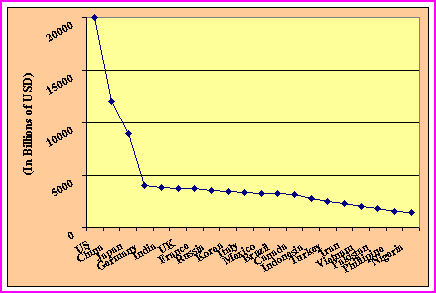
Based on a recent report published by Goldman Sachs (US based global investment bank), within the ranks of so-called BRIC Nations making remarkable strides are not only Brazil and Russia (in addition to India and China), but also a new group of highly populated, resource-rich countries numbering about 11; including Indonesia, Pakistan Vietnam, Philippine, Turkey, and Nigeria – yes Nigeria. Based on the analysis, these countries are well-positioned to assume commanding heights in the future global economy. The forecast indicated that Nigeria might become one of the twenty largest economies by 2025 if it gets its act together.
| Top Twenty Economies In 2025 (According to Goldman Sachs – US based Investment Bank)
|
advertisement
|
…Myth Or Reality
The prospect of that occurring, analyzed against the backdrop of current
situation seem quite remote, (but on closer observation it might well become
feasible). Who in his/her right mind would see Nigeria today and predict that it
could become a top-twenty economy in twenty years? The problems are simply
intractable – rampant corruption, dilapidated infrastructure, plummeting life
quality, dismal income level, incessant civil unrest, perennial resource
misapplication and so on. It is quite obvious that these systemic deficiencies
are not favorable to economic growth. So given the myriad of obstacles, on what
basis was such a conclusion reached?
After all said and done, economic modeling is an inexact science. My perception is that this forecast serves more as a clarion call to the political/business leadership than a realizable milestone. Already President Obasanjo and Minister of Federal Capital Mr. Nasir El-Rufai were quoted as saying that Nigeria will indeed aspire to attain that lofty position. An ambitious space program geared on putting a Nigerian in space and launching space satellites locally within the next 10-15 years has already been unveiled to predict ecological disaster and tackle rural poverty. If Nigerian technocrats would seriously heed the wake-up call and face impending challenges, then this might be realized.
The track record of emerging markets like China, India or Brazil should be a good benchmark for Nigeria and indeed Africa. That experience is showing a road map on how countries in this millennium would leapfrog their way out of backwardness through the use of information and telecommunication technology. The outcome could eventually prove that economic advancement after all is not rocket science (if it is; then technological processes/tools are increasingly accessible to anyone who strongly aspires to acquire it). Secondly, this would lay bare the myth that economic prosperity is alien to some societies or peculiar to only the northern hemisphere.
…Larger, Then What?
Historically, there are several growth paths that every country has
followed. That not withstanding, a common thread runs through all economies.
Fortunately, the post world war, ideological bickering between capitalism versus
socialism is now confined to history with the triumph of free market. The size of
population and availability of natural resources are vital ingredients for
economic strength and sustainability, but not necessary a determinant of social
well-being. Japan, with a large population but resource-poor or Nordic
countries (Norway, Denmark, Sweden, Finland), that are resource-rich (crude oil,
forestry, marine) with a small population all attest to that conventional
wisdom.
In today’s world essentially, access to information/education, personal freedom, political/business environment, how human capital is deplored, and how technological tools are utilized in any given society will ultimately define the extent of economic advancement. When countries are endowed with or have access to natural resources (within or outside their territory) as in the case of the United States or Western Europe (from the colonies) that more or less also helps stimulate long-term growth and engender prosperity.
This maxim however runs counter to the often-quoted theory about “natural resource curse” plaguing African countries. The conditions of some countries like Nigeria simply defies logic, which despite being so endowed, remains dirt-poor. One thought that adds substance to the top-twenty prognosis is that, given the volume of natural resources and conducive geographical environment in Nigeria, if the underlined cause of backwardness were to be isolated and tackled squarely - such as corruption, political instability, mismanagement, and ineptitude, it is quite possible that this prediction could materialize within the foreseeable future. Quick note of caution - economic size per se wouldn't automatically translate into comfortable life-style for all and sundry in an obscure arena like Nigeria. The countries with the highest per capita income are not necessarily those with the largest economies and vise versa (as the chart below shows). The good news however is that an economy that is large enough, well-managed, adequately productive with efficient and functional infrastructure will be capable of delivering significant value to the populace - income level, standard of living and employment opportunity will be higher, while social tension could be ameliorated considerably.

…Efficiency Is Key
Larger economies in the emerging market will for long be no match with
efficient and affluent societies in Europe and North America, but with time
life-standard amongst middle class people worldwide will continuously level-up.
Unfortunately even developing countries with enviable growth rate remain mired
in socio-political conflict. Recent report of gang violence in Brazil indicated
a death toll of nearly 100 people around the prisons and streets. Despite
its technological prowess, India remains somewhat politically volatile and
risky with an overwhelming majority living in abject poverty. Intermittent riots
and violence during elections are still quite common despite it being
considered the world’s largest democracy. China for all its economic strides remain
a communist country with limited personal freedom and lacking the rule of
law. Latest figures show that about 80% of Indians still subsist on less than $2
a days, compared to China where that ratio has dropped to less than 50%.
As empirical evidence in advanced countries suggest, there is a direct correlation between income level, home ownership, rule of law, access to capital/information, equal opportunity and economic prosperity. Nations can hardly attain developed status and high standard of living for the majority without these key attributes. As poor countries emerge from underdevelopment in a new global village it is instructive that they utilize every opportunity to strive for not just quantitative growth, but also qualitative transformation that is measurable in the living conditions of its people.
The countries listed in the chart above are a mixed bag of sorts. Smaller countries like Luxemburg, Qatar and Ireland still boast higher average standard of living than large ones. The economic giants for the most part have more social tension and quality of life issues to contend with. So for all intents and purposes the task for Nigerian technocrats shouldn't be to only build a larger economic pie, but to ensure that the gains are equitably distributed amongst disparate groups within the society, only then can size be justified.

Chamberlain is the Founder & President of New Era Capital Corp. and MyCompleteFinance.com, a New York based financial services group. He was previously a Financial Advisor in the Global Private Client Group, of Merrill Lynch.