Book: through the window of a sandcastle
Author: amu nnadi
Year of Publication: 2013
Publishers: Parresia Publishers Ltd, Lagos
Reviewer: Chigachi Eke
Email: [email protected]
 frica won the cultural identity war with African Writers Series, AWS, created by Heinemann Educational Books. But when this weapon was taken away from us we lost the cultural diversity one. Globalization was defined without our input as Heinemann was sold to new owners not favourably disposed to African writers.
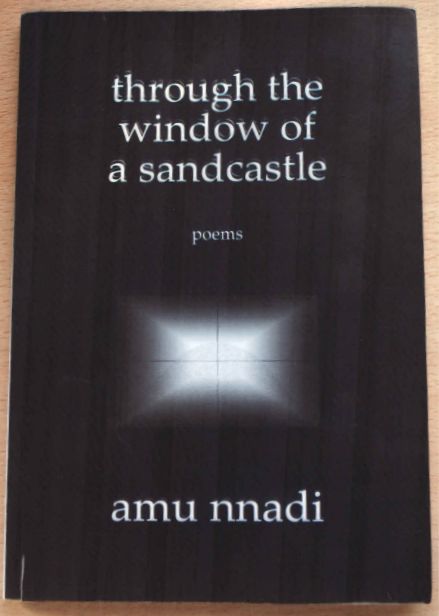
When I held a copy of amu nnadi's "through the window of a sandcastle," published by Parresia, it occurred to me that a new dawn was here for African literature. Featherweight, milk coloured and crispy; it could have been the original thing from Heinemann. My first impulse, therefore, is to shower accolades on Parresia for giving African writers a platform equal to what was under Heinemann.
Here are helpful tips for Parresia to overcome their distribution problem. One, they could partner with the pullout Sunday Magazine of The Guardian newspaper to advertise new titles and sales agents. Secondly, Parresia could partner with major Nollywood marketers with distribution outlets. Best sellers and blockbusters have same customers.
A Niger Delta Trilogy
Mindful of continuity amu nnadi situates his poetry as a progression of a consciousness, "We need to eulogise our heroes or their heroic deeds, to set examples for people. We need to make heroes that people can look up to. That is, indeed, the stuff of epic; heroism, that is. It is the key to the passion we share for the arts, for it lights the fire within us, sets us on the path of pilgrimage" (As published (ed.) in ThisDay, Nigeria, 2004. Quoted in "pilgrim s passage," p. 210). His first collection, "the fire within" (2002), is followed by "pilgrim s passage" (2004). With his 2013 "through the window of a sandcastle," a trilogy emerges.
The works are "inspired by the things I have seen at work (in the Niger Delta Development Commission, NDDC), around the (Niger Delta) region, by the people I have met, in the (struggle) traditions I have become part of, which present a montage of memorable images out of which one can distil one or two poems" (ThisDay as quoted in "pilgrim s"). Their peculiarity qualifies them for mention within the corpus of new works called the Niger Delta literature, a literature that engages the status quo from peripheral perspective with change in mind. But this perspective is site for contestation. Put mildly, who qualifies to write this literature?
If the Yoruba-born Femi Falana who defended the murdered Ogoni activists publishes his memoir emanating from that trial, can such writing be cited as Niger Delta literature? An Urhobo writer born and bred in Germany who has never set foot in the Niger Delta, can his novel written in German pass for same? Is minority literature synonymous with Niger Delta literature? We may soon have to grapple with these questions as we did in authorship of African literature. Identity can be a problem in a Nigeria polarized by majority/minority, riverine/upland and Christian/Muslim dichotomies. But for this exercise let us see how amu nnadi sees himself as a Niger Delta poet.
Born into a middle class Igbo family, his mathematician father was pioneer student of the University College Ibadan. amu nnadi defines himself as a product of our shared values, "What gives us an identity is not only lineage or birthplace, but our experiences that are defined by our loyalties and our encounters and by our particular environment" (ThisDay as quoted in "pilgrim s"). He is more concerned with the quality of our humanity than identity. He declares his brotherhood of man where race, class and ethnicity are but "commas" superseded by our common stream of humanity: "our lives are a/seamless stream/of many commas/but no stops" ("sandcastle," p.vi).
And who are his heroes? They are human rights icons like Gabriel Okara ("the voice laments"), Moshood Abiola ("better dust than drift"), and Ken Saro-Wiwa ("epitaph"). Timi Alaibe is idolized ("timi"). The great Felix Tuodolo may have given the youth the Kaiama Declaration; Alaibe saved the day by promoting the arts over arms. As head of NDDC, Alaibe calculated that a youth sent to the West for training would return to find the mosquito-infested creeks, creeks provided cover for militants, unattractive having seen the bright side of life. It was a brilliant wager except that the beneficiary could not feel at home in the Niger Delta anymore. Ian Morris calls that the paradox of development.
The three works are similar in their exploration of subjects like the Niger Delta question, nationalism, refugees, military brutality, suffering, alienation, loss and death. On the lighter side they deal with personal experiences like family life, beauty, hope, rebirth, self-definition and love. The expansive African environment and its rolling hills are celebrated against the constricting coldness of Europe. A frequent traveler to Europe and North America, his alienation in these advanced societies betrays his intense longing for pristine Africa where the chickens roam freely. He talks about his homeland with the same effervescent love typical of most exiles. With amu nnadi physical distance is not defined by miles but emotions.
"through the window of a sandcastle"
A collection of 69 poems, the book is divided into four parts: "wreaths," "voyages," "garlands" and "and milestones." These divisions are arbitrary with little bearing on the poet's perception of reality or art form. His free style is characterized by the deliberate absence of punctuations leading to seamless narration. One section flawlessly flows into another or be read as a single verse with cognitive form and content. The beauty of seamlessness is that it creates abstracts in the mind eye like a Picasso: A beautiful woman dissolves into the ravaged landscape of the Niger Delta, which in turn takes the shape of a homeless hermit, winter in London, stranded refugees, decrepit Nsukka, etc. The effect is surreal.
But does it mean there is no distinction in amu nnadi's poetry? The answer is no. In this m�lange of verses there exist perceptible differences. I closely studied more than a hundred of them and my overwhelming impression is that his trilogy contains elegies, love poems, travelogues, romantic verses or poems dealing with nature and, in particular, militant poems. To a limited extent I tried classifying them in "War Verses in amu nnadi's pilgrim s passage" (Google). With the publication of "sandcastle" there is an urgent need for a systematic study of amu nnadi's works to put to rest the issue of classification.
Audience
This modest review takes into consideration the period of writing. By 2000 globalization was here. Some Nigerian families lived simultaneously in multiple continents and a sizeable population overseas formed the Nigerians in the Diaspora Organisation, NIDO. The African Independent Television and Cable News Network beamed Nigerian news worldwide. As long as "sandcastle" is concerned, my contention remains that the poet commands a global audience. This is reflected in verses like "arlington," "london aisles," and "manhattan;" as well as in his appropriation of temperate autumn, winter, snow, thames and springtime.
The audience also includes the living and the dead. In the dirge, "alaere," the poet directly addresses the departed expressing how empty life has become: "you fly away as the eagle, alaere/�and leave us, our faces to the sun/feet stuck into shifting earth/staring into empty eternity." The poet says that the grief of those left behind is deeper than the unhappy solitary grave holding the human remains of the departed at Trofani. Trofani is probably a creek town in Bayelsa State of the Niger Delta. By so addressing the departed the poet also reminds us the living that one day "we wither and die" and so must emulate the good qualities of the departed which include being "constant," "relentless" and "resolute."
Diction
The language of "sandcastle" is dignified and formal. This says a lot about the poet's background as a journalist. He approaches his subject matter with descriptive words that best convey his feelings: "I break bread of bricks/chewing slowly it disintegrates into dust/fills my mouth, fills/my heart with ashes of yeasted dreams," ("old dreams"). "Yeasted" is metaphor for "wasted" and it is used in a manner that presents no problem for the reader at the level of semantics.
But the power of amu nnadi's diction lies in his appropriation of Biblical terms and images. There is reason for this: In Black Consciousness it is an established fact that black people are very religious and anyone trying to influence them by deemphasizing religion will never succeed. To convince his readers on the righteousness of his struggle the poet carefully introduces words with hermeneutic effect. He gently leads them from the known to the unknown, from Biblical prophesies to philosophical probabilities, by talking religion, "walls sprout across me/it is jericho once more/and dreams dog my night/I can't scream enough," he earnestly prays in "river of darkness," "I embrace you to find canaan lord."
In "golgotha" he comes across as the unarmed prophet with nothing but a "pen in my hand/as the rod of moses." He laments his bodily torture which he compares with the scourging of our Lord on the pillar while the faithless Peter lied: "their branches flog me and draw blood/sweet jesus they draw blood/and peter squats before bonfires of my heart/an ancient lie on his lips." As Christ redeemed the world with his precious blood at Golgotha, so is this humble follower of Christ prepared to shed his own blood for the masses, "hoping to bleed, hoping to be/hoping my blood irrigates this earth/hoping my death is not in vain."
With such graphic language couched from the very passion of Christ, any reader with a vestige of imagination should be forgiven for seeing amu nnadi as Agnus Dei (Lamb of God) or the Suffering Servant of God of Isaiah 53.



 advertisement

